Why the Phrase “Antifa Are the Real Fascists” Confuses Political Debate
 ">Moderateur
Follow on X
Send an email
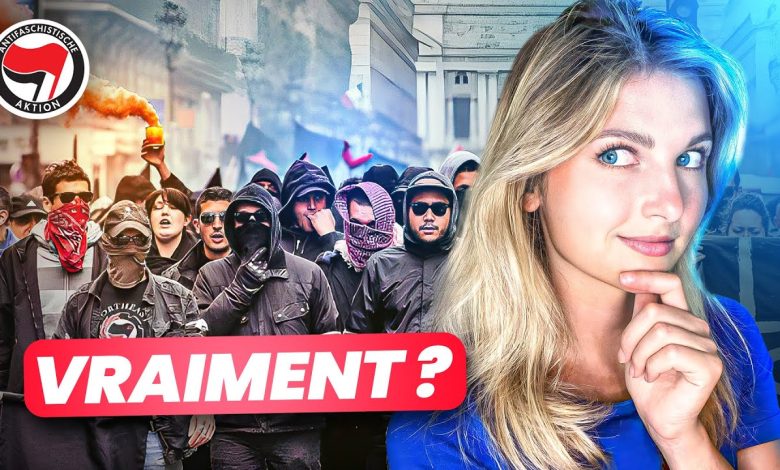
When an activist or group identified with the left commits an assault, damages posters, or seeks to prevent a meeting from taking place, one phrase regularly reappears: “Antifa are the real fascists.” It is intended to denounce an apparent contradiction between a stated commitment to anti-fascism and the use of violence.
This reaction is understandable in the immediate sense: when faced with an insult or an attack, it is tempting to turn the accusation back on the person making it. But the phrase raises an issue of precision. It implicitly equates all political violence with fascism and ultimately obscures, rather than clarifies, the nature of the acts being condemned.
A phrase built on several shortcuts
Saying that anti-fascists are “the real fascists” first suggests that fascism holds a kind of historical monopoly on political violence. Yet violence in political conflicts predates the fascisms of the 1920s and 1930s by a long way. The French Revolution, in particular, included episodes of political violence more than a century before that period.
Fascism openly celebrated violence and incorporated it into its political action. This does not mean, however, that its opponents, or other political forces in other eras, were always nonviolent. Reducing fascism to violence alone therefore prevents a distinction from being made between a specific ideology and a method of action used by very different movements.
The phrase also assumes that historical anti-fascism was inherently peaceful and that violent activists necessarily betray that legacy. This interpretation does not match the historical picture of political confrontations during the interwar period.
Historical anti-fascism did not emerge in a peaceful context
Anti-fascist movements took shape in the 1920s, first in Italy in opposition to Benito Mussolini’s National Fascist Party, then in Germany amid the rise of National Socialism. At the time, they did not form a homogeneous bloc.
In Germany, communists and social democrats each organized their own structures. From 1928 onward, the communist movement gave priority to the struggle against the social democrats, who were also described as opponents. The communists established Antifascist Action, associated with red flags. The social democrats, for their part, relied on the Iron Front, an anti-Nazi alliance symbolized by three arrows.
The Popular Front strategy was not adopted until 1935, at the Seventh Congress of the Communist International, with the aim of forging a broader alliance of left-wing forces from an anti-capitalist and anti-fascist perspective.
Between the early 1920s and the late 1930s, street clashes were frequent in Germany. Fighting between fascists and anti-fascists caused casualties. In this context, anti-fascism did not present itself solely as a movement of persuasion or peaceful mobilization: it developed during a period in which physical confrontation was also part of the political repertoire.
Criticizing violence without using a misleading equivalence
Contemporary anti-fascist organizations or activists may advocate actions intended to prevent people, parties, or associations they describe as fascist from expressing themselves. Practices mentioned include damaging posters and disrupting demonstrations, conferences, or other gatherings.
These acts can be criticized for what they are: violations against people, property, or the ability to organize and hold a debate. Describing them precisely makes it possible to demand accountability without erasing the differences between political doctrines, groups, and particular events.
The term “fascist” is often used as an insult or as a means of disqualification. When it is used to place political opponents indiscriminately into the same category, it impoverishes the debate and makes it harder to analyze the positions actually being defended. But responding with an automatic symmetry—“you are the real fascists”—retains the same mechanism of disqualification.
An accusation does not become more accurate simply because it is directed back at the person who made it. Debate becomes more robust when it focuses on verifiable behavior: violence, intimidation, censorship, property damage, calls for exclusion, or obstruction of freedom of assembly.
Fascism, communism, and the memory of political crimes
Rejecting fascism should not lead to minimizing crimes committed in the name of other ideologies. The history of tyranny and mass violence is not limited to a single political current. From this perspective, recalling the victims of communist regimes does not mean automatically equating every left-wing activist with those regimes, any more than recalling fascist crimes permits indiscriminately labeling every person on the right.
This distinction is essential. It avoids two dead ends: indulgence toward violence committed by one’s own side, and the use of historical crimes to broadly disqualify present-day opponents. A rigorous political discussion can condemn violence from the far right as well as the far left without automatically establishing a hierarchy based on the identity of those responsible.
Naming the facts rather than repeating the insult
The phrase “Antifa are the real fascists” is therefore unconvincing because it turns a legitimate criticism of certain acts of violence into a historical and ideological equivalence. It implies that violence was alien to historical anti-fascism, even though anti-fascism developed in a context of extremely harsh confrontations.
It also risks trivializing the meaning of the word “fascism” by reducing it to a mere synonym for brutality. Yet a political term can only be useful if it retains a sufficiently precise definition.
When confronting political violence, the issue is not to win a battle of labels. It is to describe the facts, identify those responsible, reject partisan justifications, and defend the conditions for political disagreement that does not descend into either intimidation or assault.
Frequently asked questions
Why is the phrase “Antifa are the real fascists” imprecise?
It conflates political violence with fascism. Yet violence has existed in many contexts and among different movements; on its own, it is not enough to define a fascist ideology.
Was historical anti-fascism entirely peaceful?
No. During the interwar period, particularly in Germany, anti-fascist structures operated in a climate of street clashes and political violence involving several sides.
How can violence committed in the name of anti-fascism be criticized?
It is more precise to describe the acts concerned—assault, intimidation, property damage, or obstruction of a meeting—rather than using a broad equivalence between anti-fascism and fascism.
 ">Moderateur
Follow on X
Send an email