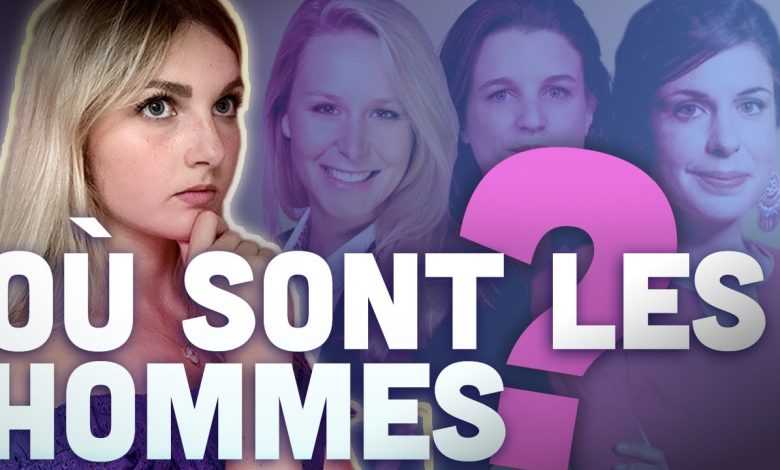
The growing visibility of women involved on the right has become an increasingly discussed political and media phenomenon. From elected officials and columnists to activists and content creators, several female figures now hold a prominent place in public debate. This development raises a broader question: does the feminisation of the right reflect a communications strategy, a transformation in political engagement, or both at once?
The debate is not solely about the number of women present in organisations or the media. It also concerns the reasons for their visibility, the issues they choose to defend and the political representations associated with their presence.
Greater female visibility on the right
Marine Le Pen, Marion Maréchal, Charlotte d’Ornellas and Eugénie Bastié are among the female figures cited as contributing to women’s growing presence in public debate on the right. Alongside them, female influencers and women-only groups also help make this phenomenon more visible.
This development is sometimes interpreted as a political use of the female image. The idea is that women could become a communications asset for movements long perceived as predominantly male. Yet this interpretation is not enough to explain individual paths or the concrete forms that engagement takes.
For Thaïs d’Escufon, entering activism does not necessarily stem from the existence of already established female role models. She presents her engagement as the result of personal conviction and a desire to act, regardless of whether women are visibly represented within an organisation. From this perspective, a woman can become involved in a political structure without waiting for it to have prominent female representatives.
From activism to media exposure
Political notoriety does not always result from an initial desire to be put in the spotlight. In Thaïs d’Escufon’s case, an action held on 13 June at Place de la République in Paris, when she was on a rooftop with other Génération identitaire activists, led to the wide circulation of images on social media and significant media attention.
She points out that fourteen people were present on the roof, while questioning why her image attracted more attention. Her analysis highlights the media’s role in shaping certain public figures: a young woman who is politically engaged, highly visible and associated with a spectacular action can become a more readily identifiable symbol than an anonymous activist.
This dynamic extends beyond a single political movement. Media outlets and social networks frequently favour recognisable personalities, personal narratives and striking images. In this context, the visibility of a woman in an environment viewed as male-dominated may heighten interest among both the public and newsrooms.
Security as an issue in women’s political engagement
Among the explanations offered for the feminisation of the right is the importance of security issues. Thaïs d’Escufon believes that more women are mobilising because they feel directly affected by street harassment and sexual assault. She links this concern to her views on immigration and to a criticism of what she describes as men’s withdrawal from protecting women.
These connections reflect her political interpretation and form an important part of her argument. They help explain why security is presented as an issue likely to encourage women’s engagement on the right: not as an abstract topic, but as a matter perceived to be connected to daily life and personal autonomy.
She also points to a difference in social-media exposure, arguing that young women may be more inclined than men to show themselves online. This digital presence can facilitate the rapid emergence of political or activist figures, especially when their statements receive considerable attention.
A feminisation that does not command consensus
The feminisation of politics is sometimes welcomed as an expansion of representation and public participation. However, Thaïs d’Escufon takes a more ambivalent position. She argues that women’s increased presence should not be understood as men being replaced in the political sphere.
She maintains that men have partly withdrawn from public engagement through depoliticisation, caution or fear of the personal cost of speaking out. In her view, political exposure involves criticism, risks and constraints that may deter those reluctant to make themselves visible.
Her reasoning is based on a differentiated conception of female and male roles. She argues that power has historically and anthropologically been associated with masculinity, an idea she links in particular to arguments developed by Éric Zemmour in Le Premier Sexe. This reading is open to challenge and reflects a particular political and cultural perspective; nevertheless, it shapes her call for a more pronounced return of men to public action.
The female fighter in the political imagination
The considerable attention received by some female activists may also be explained by the enduring presence of female fighter figures in the French imagination. Marianne and Joan of Arc are mentioned as symbolic references capable of embodying authority, courage and collective mobilisation at once.
Thaïs d’Escufon observes that part of the public responds to the image of a woman who takes risks, exposes herself to scrutiny and draws others into action. She does not compare herself to these historical figures, but sees them as one element explaining the interest sparked by certain activist images.
She also mentions Guillaume Faye, an essayist associated with identitarian thought, whose writings envisaged an expanded political role for women as part of a European “regeneration.” This reference illustrates the existence, in some radical right-wing circles, of a long-standing reflection on women’s capacity to embody or trigger collective mobilisation.
Complementarity or substitution: the core of the debate
The question, then, is not simply whether more women will be present on the right. It concerns the meaning attributed to that presence. For some, it can broaden the range of profiles, experiences and voices represented in public life. For Thaïs d’Escufon, it should not lead to the view that women can or should occupy alone the space left vacant by men.
Her position rests on the idea of complementarity between the sexes rather than their interchangeability. She calls on men who share her political concerns to become involved as well, viewing the emergence of highly visible women as an incentive to act rather than a reason to withdraw.
The feminisation of the right therefore appears as a phenomenon with several dimensions: media-related, activist, generational and ideological. It reveals both women’s greater access to political expression and the continuing tensions surrounding authority, representation and the distribution of roles between women and men.
FAQ
Why do people speak of the feminisation of the right?
The expression refers to the growing visibility of women involved on the right, whether they are elected officials, columnists, activists or content creators. It relates both to their presence in public debate and to the media attention they receive.
Is women’s presence on the right a communications strategy?
This interpretation exists, but it cannot on its own explain individual forms of engagement. Personal journeys may be driven by personal convictions, the issues people defend or a desire to participate directly in political life.
What role does security play in this debate?
According to Thaïs d’Escufon, concerns related to street harassment and sexual assault are among the reasons that may lead some women to become involved on the right. This analysis is part of her own political positions on security and immigration.

 ">Moderateur
Follow on X
Send an email