Has Sidney Sweeney Become a Symbol of the Sexualization of Women’s Sports?
 ">Moderateur
Follow on X
Send an email
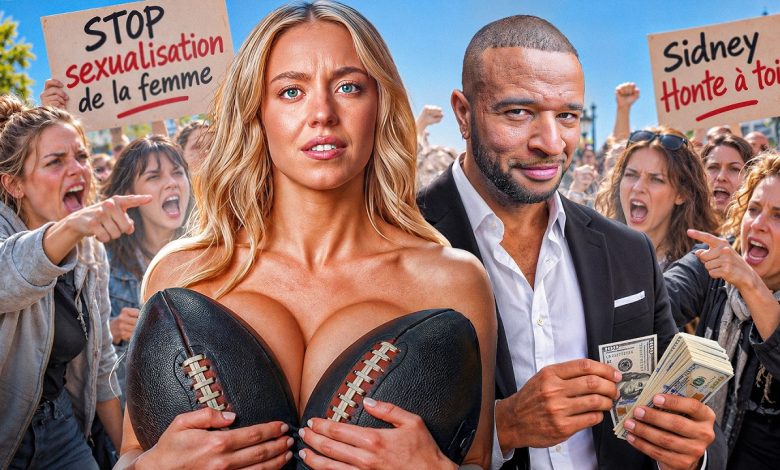
Sidney Sweeney has become one of the most discussed figures in American pop culture. The actress, who gained widespread recognition through Euphoria, has seen her public image evolve through highly visible advertising campaigns, sometimes built around references to her physique or suggestive staging. Her marketing choices do not merely prompt reactions about her personally: they fuel a broader debate about the sexualization of women’s sports.
The controversy intensified in particular following a campaign for a sports betting platform. The actress appears nude, with her body concealed by various pieces of sports equipment. For critics, the issue is not nudity alone: it lies in the use of sports imagery in an advertisement where performance, competition, and athletes take a back seat to the eroticization of the female body.
Why the campaign prompted so much reaction
Suggestive advertising is not a new phenomenon. Fashion, film, music, and brands have long relied on seduction to attract attention. But the combination of nudity, sport, and sports betting gave this campaign particular significance.
Many responses emphasized that female athletes are still fighting to be recognized for their results, technique, and hard work rather than their looks. In this context, showing a nude woman surrounded by sporting objects was interpreted by some as a reminder of an old advertising reflex: when a message is aimed primarily at a male audience, the female body becomes a universal tool for attracting attention.
Female athletes and social media users alike expressed frustration at what they viewed as a reductive portrayal. Some social media posts contrasted this imagery with women who actually practice their sport, dressed for exertion and valued for their athletic commitment.
Others, however, defended Sidney Sweeney’s freedom to decide how her image and body are presented. This position stresses that a woman can choose a sexy portrayal without that choice negating her freedom or legitimacy. The disagreement therefore concerns less the principle of nudity than its cultural, commercial, and symbolic effects in a sector already marked by inequalities in visibility.
Women’s sports and the weight of appearance
The debate extends far beyond Sidney Sweeney’s case. In many sports, female athletes regularly face media coverage that prioritizes their appearance. Their outfits, bodies, private lives, or popularity on social media can sometimes receive more attention than their performances.
This situation is particularly sensitive because women’s sports are still seeking greater media space, larger audiences, and lasting economic recognition. Players, boxers, athletes, and fighters do not necessarily want their bodies to disappear from the screen: sport is, by definition, a physical activity. What they are asking for, above all, is for their expertise and results not to be treated as secondary.
The question of images produced during competitions has become a concrete issue. Rule changes have been discussed regarding certain uniforms, particularly in volleyball, along with restrictions on camera angles considered overly suggestive. A study conducted during the Tokyo Games reportedly found that female athletes were filmed from sexualizing angles far more often.
These discussions reveal a persistent tension: making women’s sports visible is not enough if that visibility is built primarily around desire directed at athletes. For advocates of another approach, the challenge is to build an audience interested in the competitions themselves, their rivalries, their stories, and their performances.
A revealing comparison in sports advertising
The contrast with certain campaigns featuring male stars has strengthened the criticism. LeBron James has also been associated with a competing sports betting platform. His image was presented around his status as a great player and his public persona. In Sidney Sweeney’s case, attention focused heavily on the sexual dimension of the staging.
This difference reinforces an observation often made by critics: a famous man can be marketed through his talent, humor, authority, or record, whereas a highly visible woman is more readily reduced to her looks. This mechanism does not prevent women from having careers or influence; however, it can limit the way the public is invited to view them.
The issue becomes even more sensitive when campaigns draw on the world of sport. A female athlete must then compete not only with other sporting performances, but also with far more immediately viral portrayals designed to capture attention through provocation or eroticization.
Controversy as a visibility strategy
The controversies surrounding Sidney Sweeney also fit into a modern communications logic: a widely discussed campaign gains considerable visibility, whether it is praised or condemned. An American Eagle advertisement built around an English wordplay between jeans and genes had already prompted numerous political and cultural interpretations.
Another campaign, for a soap brand, attracted attention through the sale of a product presented as containing the actress’s bathwater. The product reportedly sold out quickly. These examples reinforced the idea that controversy can contribute to a campaign’s commercial reach.
From this perspective, the debate over sexualization is not solely about a celebrity’s intentions. It questions a system in which attention becomes a resource, outrage circulates content as effectively as approval, and brands may be tempted to reproduce the formats that generate the strongest reactions.
Individual freedom and public responsibility
Two principles come into tension without necessarily being incompatible. On one hand, a public figure remains free to choose their partnerships, image, and the codes they wish to use. On the other, highly visible figures help shape collective representations, especially when they reach millions of people.
The criticism aimed at the sports betting campaign is therefore not always a call for Sidney Sweeney to give up any form of emphasis on her body. Rather, it concerns the risk that sexualization may once again become an automatic marketing solution, particularly when a product is being sold to a predominantly male audience.
The debate remains open. It cannot be reduced either to an opposition between modesty and freedom or to the condemnation of one actress in particular. It raises a broader question: what place do brands, media outlets, and the public want women to have in sport? A place based on their abilities and achievements, or visibility dependent above all on their appearance?
FAQ
Why was Sidney Sweeney’s campaign criticized?
Critics believed that the use of nudity in a sporting setting once again reduced female presence to a visual selling point, at a time when women’s sports are seeking recognition for athletes’ performances.
Does the sexualization of women’s sports apply only to advertising?
No. The issue also concerns imposed uniforms, television production choices, camera angles, media coverage, and the way athletes are presented on social media.
Can Sidney Sweeney’s freedom be defended while still criticizing the campaign?
Yes. It is possible to recognize her right to choose her image while questioning the collective consequences of an advertising strategy that uses the female body as its main means of capturing attention.
 ">Moderateur
Follow on X
Send an email